
Weak film that offers little in the way of context for those unfamiliar with the French music scene. Moreover, the non-French may find the subtlety of the cultural references too obscure to be either meaningful or entertaining.
The eponymous character never comes alive as a character and we do not emotionally engage with him as we should - unlike Marion Cotillard in La Vie en Rose. This is little more than a parade of famous French celebrities without any real depth as drama - albeit with some rather good music.
The central theme of the negative psychological affects of White supremacism is never explored - as if it were a given requiring no elaboration. Having affairs with beautiful women was little more than a vain means of purchasing a sense of being attractive as a man when the White world likes to depict Jews as physically repulsive.
Wednesday, 6 October 2010
Gainsbourg
[Vie héroïque]
(2010)


Tuesday, 5 October 2010
Notting Hill
(1999)
| RATING: | 100% |
| FORMAT: | DVD |

Hugh GRANT's self-effacing charm is well to the fore here even to the extent of it controlling the usually-frenetic editing style of English-language movies by slowing it down to match his more languid pace. Here the characters develop and enrich before your eyes so that you get to know and to empathize with them. Julia ROBERTS manages to convince us that she is not a Hollywood film star even when she is playing one, which takes her special talent, looks and ability to emotionally-connect with the audience. Without these two very special performers, this film would fall desperately into romantic-comedy formalism. Rhys IFANS is also notable as a sleazebag flatmate-from-hell, who is as laughable as he is laugh-inducing. All of the performers, in fact, are impeccably cast in representing the loneliness and self-serving miserableness of the White middle-class life satirised here.
Unusually for a romantic comedy this is profoundly character-driven piece and written to such a very high standard that it is actually funny. The Roman Holiday, princess-kissing-the-frog quality to the story and themes is well conveyed without it being too obvious that this is, in fact, a classic European folk tale. The writer (Richard CURTIS) is to be congratulated for employing snappy one-liners that the actors can actually get behind and make even funnier than they appeared on paper. The jokes do not overwhelm the story and so enhance it magnificently. His disquisition on a paparazzi-fed culture lacks substance, however, and we remain imprisoned in our own outsider status regarding the film star (albeit expertly) playing a film star in this delightful wishful think-piece. The somewhat repetitive plot structure is designed to make the thing more realistic by repeating the inherent difficulties of maintaining the relationship described in the film, but makes it too long for its own good. And yet this is a true film in that it fully engages the emotions and holds ones attention throughout – a rare achievement in a Western film culture obsessed with a naturalism.
Quiet Man
(1952)

Fine romantic-comedy set in a fictional Ireland but shot in the real place. What makes this cliché-ridden work enjoyable is the spunky Maureen O'Hara. Her performance is almost perfect and profoundly funny as well as ultra-feminine. This makes up for the acting deficiencies of her co-star (John Wayne) - saved by the very good chemistry between the two.
Saturday, 2 October 2010
Sting
(1973)
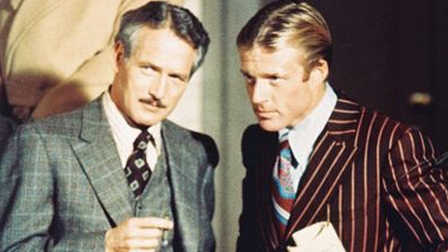
Solidly entertaining crime caper that is far more plot-driven than it should have been. It is unsophisticated regarding the nature of revenge, human greed and gullibility because it is more concerned to fool the audience with its twisting plot than present coherent, believable characters.
That you are, indeed, fooled provides the main source of pleasure to be had from this entertainment, as many of the characters are not what they seem; while others are what they do not seem. However, this fact is not used to explore the true nature of con-men and their inherent parasitism.
Another layer of meaning also remains unexplored in that the film begins with likenesses of its director and writer. This reflects the fact that the film itself was cast, directed and performed - as the scam presented here is - not only for the benefit of the man being conned but also for ours. This is all good, clean fun but ever so superficial since the characters never truly come alive.
Not as subtle as The Grifters or Paper Moon, but the style is pretty and the Ragtime music catchy. Nevertheless, the decided lack of thematic content never really allows the audience to truly engage with the drama emotionally.
Friday, 1 October 2010
Zona
(2007)

Clever critique of gated communities and their false unity based on hating the outside world. Like monasteries and convents, such institutions become prisons for their inhabitants as they retreat from worldly responsibility into a world where affiliation is based on an ever decreasing gene pool of available friends and marriage partners. This leads to the increasingly hostility and self-destructive tendencies on show here, as the community must be protected at all costs. What price social snobbery is the question being asked when the culture so created is more concerned with simply surviving than with developing, enhancing and improving.
The increasing desire for protection from the lower-class created by the very social snobbery that fears its own creation induces the characters here to seek physical segregation. But this is security at the price of genuine knowledge of the world and of how to make the best of things because no objective criteria for social acceptance is ever established or wanted - just the vague feeling that one is secure. Only the worst kind of people want to live that way because they hope to hide their true selves from a world they want to control to suit their own pre existing ideology.
A thriller that is about more than just cheap thrills yet which never fully explains the reasoning behind its existence - irrational fear. Yet the characterization and acting is superb; making the movie completely engrossing. All the characters speak from their own point of view and not just from the creator's viewpoint so that we come to understand them as people not just as a motley collection of heroes and villains. A kind of Escape from New York in reverse.
Science:

Sleep of Reason:
The dream of reason produces monsters. Imagination deserted by reason creates impossible, useless thoughts. United with reason, imagination is the mother of all art and the source of all its beauty.
 (1746-1828), Spanish painter. Caption to Caprichos, number 43, a series of eighty etchings completed in 1798, satirical and grotesque in form.
Humans & Aliens:
I am human and let nothing human be alien to me.
 (circa 190-159 BC), Roman dramatist. Chremes, in The Self-Tormentor [Heauton Timorumenos], act 1, scene 1.
Führerprinzip:
One leader, one people, signifies one master and millions of slaves… There is no organ of conciliation or mediation interposed between the leader and the people, nothing in fact but the apparatus - in other words, the party - which is the emanation of the leader and the tool of his will to oppress. In this way the first and sole principle of this degraded form of mysticism is born, the Führerprinzip, which restores idolatry and a debased deity to the world of nihilism.
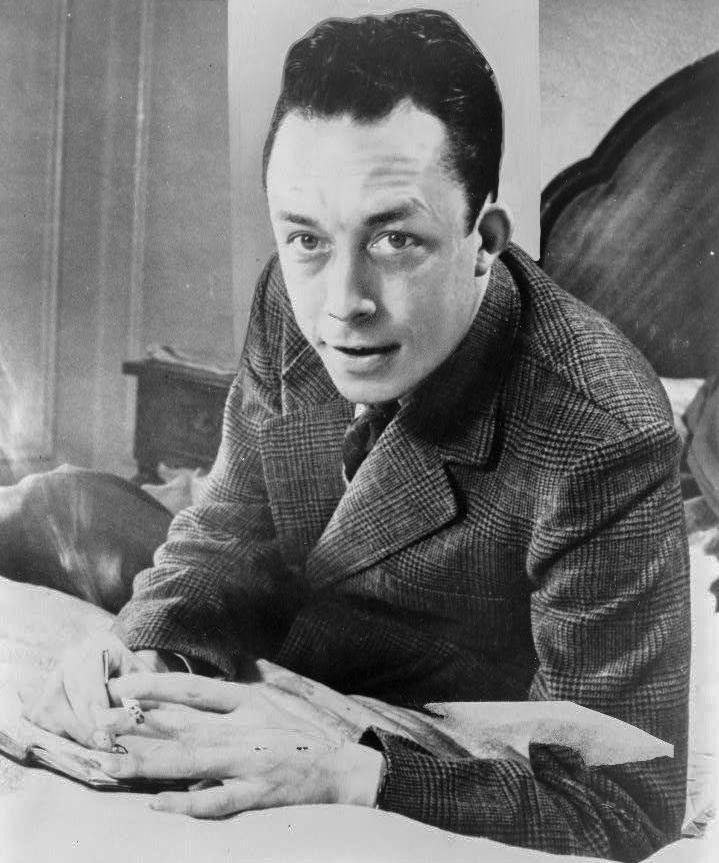 (1913-60), French-Algerian writer & philosopher. The Rebel: An Essay on Man in Revolt: New York: Vintage Books, (1984; page 182.)